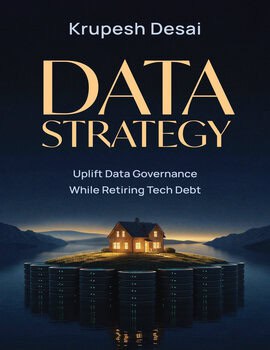
Data Strategy: Uplift Data Governance While Retiring Tech Debt, by Krupesh Desai
Turn legacy system retirement into an opportunity to strengthen data governance and build lasting control over your organization’s information.
Topics
Part I: Why Governance Fails
Chapter 1: The Larger Picture, Revisited
1.1 Governing the Management of Data
1.2 The Golden Opportunity
1.3 Task for Monday
Chapter 2: Governance Is a Capability, Not a State
2.1 Scale the Definition
2.2 Society Never Stops Making Laws
2.3 Trust, Transparency, Auditability
2.4 The Survival Test
2.5 Task for Monday
Chapter 3: The Appetite
3.1 The Commitment Ladder
3.2 Reading the Appetite
3.3 Task for Monday
Chapter 4: The Governance Vacuum
4.1 The Three Faces of the Vacuum
4.2 Goodwill Is Not a Control
4.3 Power Made Accountable
4.4 Task for Monday
Part II: Doing It
Chapter 5: Start With Discovery
5.1 What the Foundation Phase Produces
5.2 Scope Gives You Retention, Then the System List
5.3 Data Segment Gives You the Unit of Governance
5.4 People & Technology Gives You the Roles
5.5 Documents First, Then People
5.6 Discovery Also Measures Maturity
5.7 Task for Monday
Chapter 6: Roles That Survive
6.1 Governance Is Already Happening
6.2 Three Roles, Found Not Invented
6.3 Primary and Delegate
6.4 Validation, Not Nomination
6.5 Roles Attach to People, Not Projects
6.6 Task for Monday
Chapter 7: The Conformance Chain
7.1 The Chain
7.2 Sentencing a Segment
7.3 Five Dispositions, and Nothing Is Lost
7.4 From Register to WHERE Condition
7.5 From Seed to Chain
7.6 Task for Monday
Chapter 8: Registers, Not Documents
8.1 A List With Memory
8.2 The Few Lists That Matter
8.3 Evidence, Not Assertion
8.4 Task for Monday
Chapter 9: The Committee That Decides
9.1 Charter First
9.2 Decide at the Lowest Level That Works
9.3 Who Sits, Who Votes
9.4 Quorum, Minutes, and the Hour That Matters
9.5 When It Will Not Meet or Cannot Decide
9.6 Task for Monday
Chapter 10: The Performance Side
10.1 Start With the Objective
10.2 One Architecture, Any Sector
10.3 Definitions Before Deduplication
10.4 Master the Cohort That Matters
10.5 Quality With an Owner
10.6 The Migration Funds the Fix
10.7 Task for Monday
Part III: Making It Travel
Chapter 11: Compliance as a By-Product
11.1 Start With the Red Flags
11.2 One Discovery, Many Obligations
11.3 Policy You Can Audit
11.4 The Honest Limit
11.5 Task for Monday
Chapter 12: Same Core, Different Laws
12.1 The Core Barely Changes
12.2 Only the Overlay Moves
12.3 The Chain Across Borders
12.4 Privacy Is Timely Access, Too
12.5 Task for Monday
Chapter 13: Handing It Over
13.1 Dependency or Capability
13.2 Start, Stabilize, Transition
13.3 The Runbook and the Capability Assessment
13.4 The Test
13.5 Task for Monday
Chapter 14: The Question Set
14.1 For the Executive
14.2 For the Person Holding the Mandate
14.3 The Five Discovery Questions
14.4 Every Task for Monday
The Last Question
Executives, data governance professionals, and technology leaders will learn how to use system replacement initiatives to establish accountable, sustainable data management practices.
Many organizations invest heavily in data migration while overlooking the governance weaknesses their projects expose. Unclear ownership, inconsistent definitions, undocumented decisions, and uncertain retention requirements create risks that persist long after implementation. Drawing on a real-world engagement involving sixteen core systems at an Australian municipal council, this book demonstrates how structured discovery can address these weaknesses while supporting migration planning. It builds on the method in the author’s earlier book, Data Migration Framework: Removing the Tech Debt.
Apply a practical data governance framework that connects legal obligations to specific data assets and defensible retention decisions. Find the business owners, data stewards, and IT custodians already doing the work, and make their roles formal. Establish actionable governance registers, decision-making committees, and audit trails that provide evidence of compliance. Evaluate what information should be migrated, archived, or lawfully destroyed, and document the reasoning behind each decision.
Move beyond regulatory compliance to improve data quality, master data management, and organizational performance. Align governance activities with business objectives, establish consistent definitions, and prioritize the information that matters most. Practical examples, reusable methods, and focused exercises show how to build capabilities that remain effective after consultants and project teams depart.
Build a governance capability your organization can operate, maintain, and trust. Put the methods in this book to work.
About Krupesh
Krupesh Desai is a Certified Data Management Professional (CDMP) with more than fifteen years spent solving hard data problems across industries. He started as a software engineer in database recovery and replication, and grew through data migration, integration, governance, and enterprise data strategy. He spent more than a decade in New Zealand, where he led multiple legacy decommissioning and migration programs in the public health sector, delivering migration and analytics solutions with business continuity intact. He is now based in Melbourne, Australia.
He is the author of Data Migration Framework: Removing the Tech Debt (Technics Publications, 2025), a practical guide to moving legacy data from discovery to cutover while lifting governance maturity along the way. This second book comes from practicing what the first one preached, applying its method end to end in the field. That framework has since grown into Data View House, a governance platform he founded, where every piece of data carries the law that binds it at each stage of its life.
Bestsellers
Faculty may request complimentary digital desk copies