
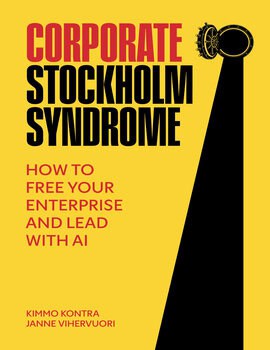
Corporate Stockholm Syndrome: How to Free Your Enterprise and Lead With AI, by Kimmo Kontra and Janne Vihervuori
Break the structural traps that keep major enterprise initiatives over budget, behind schedule, and disconnected from the outcomes they were meant to deliver.
Foreword
Prelude
Introduction
Part I: Inside the Vault
Chapter 1: The Hostage Situation
Chapter 2: The World of Shadows
Chapter 3: The Fallacy of One
Chapter 4: The Flood of Governances
Chapter 5: Slide Deck as the Executive Security Blanket
Chapter 6: Gonglomerate, Inc.
Part II: The Liberation
Chapter 7: Abundance and Scarcity
Chapter 8: The Organizational Brain
Chapter 9: The Infinite Optionality Engine
Chapter 10: Greenfield Thinking as Optionality Superpower
Chapter 11: Orchestration Governance
Chapter 12: Curing the Syndrome
Part III: After the Liberation Day
Chapter 13: Living in a Computable Enterprise
Chapter 14: A Day in the Life in a Liberated Enterprise
Chapter 15: Don’t Resurrect the Syndrome
Epilogue
Appendix A: The Anatomy of the Organizational Brain
Appendix B: Antifragility: Thriving on Chaos
Break the structural traps that keep major enterprise initiatives over budget, behind schedule, and disconnected from the outcomes they were meant to deliver. Corporate Stockholm Syndrome is a practitioner-focused book for leaders, architects, program professionals, and business, IT, and data teams who want a more coherent way to manage enterprise change in the age of AI.
The book diagnoses a recurring pattern: organizations fragment strategy, processes, systems, data, governance, and decision authority, then normalize the workarounds and delays that follow. It shows how shadow IT, shadow data, monolithic platform thinking, proliferating governance committees, and static slide decks can hide the real operating structure of an enterprise and weaken the link between strategic intent and execution.
From that diagnosis, the book develops a practical alternative built around the Organizational Brain, a maintained, human-owned record of intent, context, commitments, authority, and evidence that people can read and AI can use. Readers can evaluate how strategy connects to investments, test assumptions against evidence, create living specifications, and replace fragmented handoffs with a connected model of what the organization wants and why.
The book also examines AI-driven abundance, the Infinite Optionality Engine, Greenfield Thinking, Orchestration Governance, antifragility, and the Spec-Driven Organization. Together, these ideas help readers compare alternatives before committing, rethink legacy constraints from first principles, govern cross-functional seams, and design a computable enterprise in which machine-generated outputs remain anchored to human judgment and accountability.
Ideal for executives, enterprise architects, enterprise change leaders, data and AI leaders, program managers, consultants, and practitioners responsible for complex change, this book offers a structural way to analyze enterprise failure and build more coherent execution. Read it to move beyond another tool, platform, or methodology and start changing how your organization knows itself.
“Today’s organizations are unfit for data and AI. Making them fit is THE management challenge of our time! Corporate Stockholm Syndrome is for those with the courage to take it on, the wisdom to do away with paradigms past their “sell-by” date, the imagination to find new solutions, and the persistence to try those solutions, fail, learn, and try again.”
Tom C. Redman, “The Data Doc”, President, Data Quality Solutions
“Enterprises have learned to live with IT projects that miss budgets and schedules, silos that block cooperation, and strategy that gets lost in translation. Vihervuori and Kontra ask whether this has to be inevitable. Their Organizational Brain offers a sharp, practical alternative, and the journey there is familiar, funny, and genuinely thought-provoking at the same time. A must-read for corporate leaders!”
Ville Voipio, Chair of the Board, Vaisala
“The great risk is that we use AI to build faster horses for organisations that need an entirely different way of knowing and running themselves. Corporate Stockholm Syndrome brilliantly diagnoses why large organisations become hostages to their own structures—and, more importantly, shows how AI can help set them free without surrendering human judgment.”
Bo Harald, Co-founder of MyData Global, pioneer in internet banking
“Any board member or leader without an engineering background will chuckle at the many relevant examples and quotes from bureaucrats struggling with the IT-department. But the stories have a mission, and that is to emphasize the importance of collecting and standardizing data so that it is as useful as possible in the AI-era. The book is a must read for decision makers.”
Jan Ludvig Andreassen, Chief Economist, Eika Gruppen
“You had me at ‘1 in 200.’ That is the success rate the authors cite for IT projects, a disturbing number most of us have lived through more than once. They call it an organizational hostage situation, and the label fits. This witty, sharply analytical book is driven by a worried optimism: an honest look at who we are as organizations, and how we can break free from silos and conflicting agendas. It belongs on the reading list of the entire leadership team. IT is no longer a department. It is part of everyone’s job, and so is fixing it.”
Nermin Hairedin, Board Member, Advisor and Executive Educator
“With great clarity, Vihervuori and Kontra make it visible how large transformation projects fail because of the corporate fragmentation. If processes, data and ways of working don’t change, AI will just amplify the problems. The book offers a compelling alternative where AI is a part of a real solution. It’s a must read for every leader involved in large transformation programs.”
Niko Korte, VP Fossil Free Business Platforms, SSAB
“In large enterprises, major transformations fail with remarkable consistency, and we keep blaming the wrong things. Kontra and Vihervuori show the problem is structural: silver bullets, reorganizations and better people won’t fix it; changing how the company describes itself will. Essential reading before launching your next transformation.”
Pirkka Palomäki, Founding Partner, Maki.vc
“AI has changed the rules: companies can now process, analyse and generate information at a scale no human organisation can match. When company DNA, operating models and legacy systems remain unchanged, we may simply become much better at producing the wrong things faster. Corporate Stockholm Syndrome is essential reading for understanding this new reality and how to come out as a winner, not a bystander. The transformation will be uncomfortable. Standing still will be worse.”
Riku Helander, CEO, Digita
“Most strategies die in PowerPoint, until IT builds something nobody actually asked for. Vihervuori and Kontra refuse to accept this as normal. Write strategy as a versioned, owned spec, then let people and AI compute from it. No tool to buy, no transformation program to launch. Start small, start now. Required reading for anyone who owns strategy execution.”
Perttu Nihti, CPTO, Virta
Kimmo Kontra is a Finnish enterprise transformation advisor, entrepreneur, and author with decades of experience in data management, IT strategy, governance, and organizational design. His work connects practical transformation experience with systems thinking, exploring how organizations can overcome silos and turn strategic intent into action. He has spoken at MIT’s Chief Data Officer and Information Quality Symposium and Aalto University Executive Education events. His 2026 article “Corporate Consilience,” published in the Journal of the International Society for the Systems Sciences, develops an approach to uniting organizational knowledge in the AI era. He is the developer of the Orchestration Governance framework.
Janne Vihervuori is a Finnish enterprise transformation leader and author operating at the rare intersection of Enterprise Architecture, complex SAP landscapes, data management, and Artificial Intelligence. As Head of ERP Development and Architecture at Wärtsilä, he guides enterprise-scale SAP transformations, Clean Core governance, and AI innovation. Previously, as a Chief Enterprise Architect, he honed his expertise in strictly business-outcome-driven architecture, ensuring technology investments directly serve strategic intent. Decades of navigating business-IT friction give Janne a sharp perspective on untangling corporate complexity. He combines his EA and SAP background with extensive strategic AI consulting experience—including co-innovating GenAI concepts like SmartGen—to provide a uniquely balanced view of modern enterprise capabilities.




Please complete all fields.