
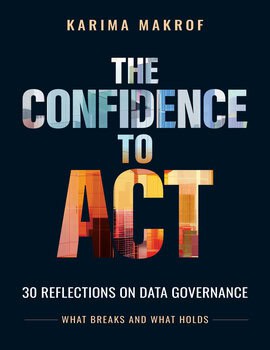
The Confidence to Act: 30 Reflections on Data Governance, by Karima Makrof
This book is built around 30 short reflections from practice – originally shared as part of the 30 Days of Data Governance series – each exploring a moment where governance either quietly works or quietly breaks down.
How to Use This Book
How Each Chapter Is Structured
Three Principles
A Note on the Examples
A Note on Language
From the 30 Days of Data Governance Posts
Looking Back From Practice
From the 30 Days of Data Governance Posts
Looking Back From Practice
From the 30 Days of Data Governance Posts
Looking Back From Practice
From the 30 Days of Data Governance Posts
Looking Back From Practice
From the 30 Days of Data Governance Posts
Looking Back From Practice
From the 30 Days of Data Governance Posts
Looking Back From Practice
From the 30 Days of Data Governance Posts
Looking Back From Practice
From the 30 Days of Data Governance Posts
Looking Back From Practice
From the 30 Days of Data Governance Posts
Looking Back From Practice
From the 30 Days of Data Governance Posts
Looking Back From Practice
From the 30 Days of Data Governance Posts
Looking Back From Practice
From the 30 Days of Data Governance Posts
Looking Back From Practice
From the 30 Days of Data Governance Posts
Looking Back From Practice
From the 30 Days of Data Governance Posts
Looking Back From Practice
From the 30 Days of Data Governance Posts
Looking Back From Practice
From the 30 Days of Data Governance Posts
Looking Back From Practice
From the 30 Days of Data Governance Posts
Looking Back From Practice
From the 30 Days of Data Governance Posts
Looking Back From Practice
From the 30 Days of Data Governance Posts
Looking Back From Practice
From the 30 Days of Data Governance Posts
Looking Back From Practice
From the 30 Days of Data Governance Posts
Looking Back From Practice
From the 30 Days of Data Governance Posts
Looking Back From Practice
From the 30 Days of Data Governance Posts
Looking Back From Practice
From the 30 Days of Data Governance Posts
Looking Back From Practice
From the 30 Days of Data Governance Posts
Looking Back From Practice
From the 30 Days of Data Governance Posts
Looking Back From Practice
From the 30 Days of Data Governance Posts
Looking Back From Practice
From the 30 Days of Data Governance Posts
Looking Back From Practice
From the 30 Days of Data Governance Posts
Looking Back From Practice
From the 30 Days of Data Governance Posts
Looking Back From Practice
A Practical Roadmap
From Governance to Confidence
Data governance doesn’t fail because people don’t care about data.
It fails because organizations try to fix complexity with frameworks instead of changing how work actually gets done.
Over years of working with leadership teams, data offices, architecture and operational teams, one pattern appears again and again: governance succeeds not when policies are written, but when responsibility becomes real in everyday decisions.
This book is different.
This book is built around 30 short reflections from practice – originally shared as part of the 30 Days of Data Governance series – each exploring a moment where governance either quietly works or quietly breaks down.
Written for leaders and practitioners who want governance that actually works in organizations, it is not another framework-heavy manual. Instead, it offers observations drawn from real situations, including:
Each chapter connects a practical governance topic – ownership, data quality, automation, stewardship, decision-making – with a reflection from real organizational experience.
Not perfect solutions.
Not theoretical models.
Just the lessons that remain after the frameworks have been tested in real situations.
This book is for leaders and practitioners who are tired of governance initiatives that look good on paper but collapse in reality. It is for anyone who wants governance that scales with the business, reduces friction instead of adding it, and turns data from a recurring problem into a strategic asset.
This book is not a comprehensive framework, a certification guide, or a tool vendor’s playbook. It is a map for the messy reality of making governance work – written by someone who’s been there.
If you’ve ever sat in a meeting where two dashboards showed different numbers and no one could explain why, this book is for you.
Everything in this book builds on one assumption: that data governance exists to serve decisions, not documentation. If you keep that in mind as you read, the rest of the journey will feel less like implementation – and more like alignment.
Because governance is not about controlling data. It is about enabling confidence.
Karima has written a book that genuinely meets people where they are in their relationship with data, growth, and self-awareness, and then gently but effectively moves them forward. What stood out to me most is how her “30 reflections” create space for people to pause, think, and reconnect with what really matters, while still nudging them toward action. In the work I have done, I often say that real change does not begin with mandates, it begins with recognition and awareness of what is already happening. Karima captures that same spirit beautifully. She recognizes that people are already thinking, already feeling, and already behaving in ways that can be shaped into something more intentional and impactful. This book does not try to force change. It acts as a catalyst for it.
Robert S. Seiner
President & Principal – KIK Consulting & Educational Services
Karima Makrof has spent over two decades in the rooms where data governance either quietly works or quietly breaks down.
Across financial services, logistics, retail, manufacturing, and technology, she has worked alongside leadership teams, data offices, architects, and operational staff – as advisor, leader, and embedded practitioner. The pattern she kept seeing was rarely about missing frameworks or absent ambition. It was about blurred ownership, uneven trust in the numbers, and governance that lived in documents rather than decisions.
She later founded her own advisory company, and continues that work with leaders and teams navigating a wide range of governance challenges: from establishing accountability structures that actually hold to rebuilding confidence in data that has quietly lost it.
Her approach is practical and clear-eyed, grounded in the reality of how organizations function under pressure, not how governance manuals say they should. She has learned to distrust complexity that exists to signal effort rather than create clarity.
She is also an endurance athlete, which may explain the instinct for discipline, the long view, and the refusal to look for shortcuts where there are none.
The Confidence to Act grew out of her “30 Days of Data Governance” LinkedIn series and reflects everything that practice taught her about what breaks and what holds.




Please complete all fields.